Real contest for power in information sphere, not just at the ballot
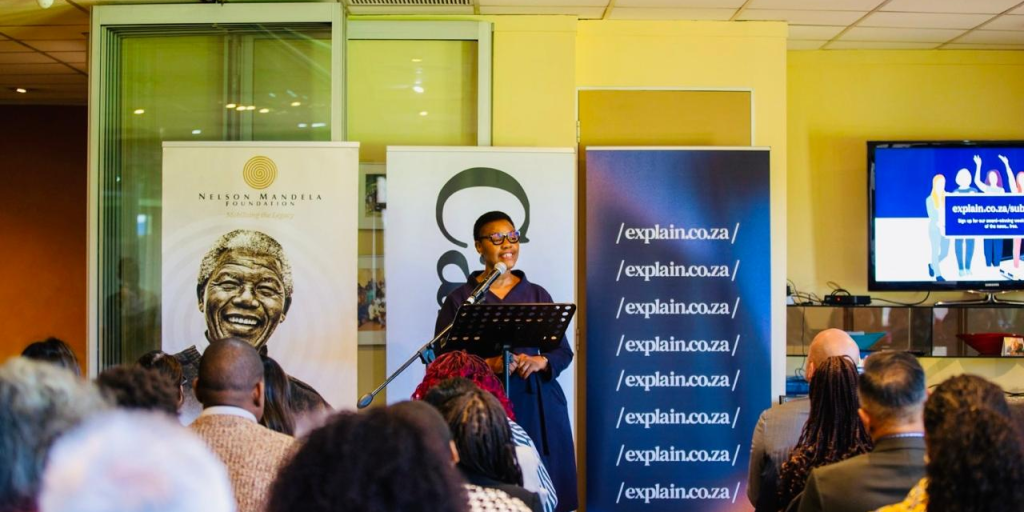
PICTURE: Phathiswa Magopeni speaking at the International Women’s Day event
On 10 March 2026, the Press Council’s Executive Director Phathiswa Magopeni gave the Keynote Address at an event to mark International Women’s Day.
Hosted by Explain News and the High Commission of Canada, When Women Switch Off also featured a panel comprising Daily Maverick Associate Editor Ferial Haffajee, news24’s Head of News Nicky Gules and Frontpage Media House‘s Managing Director Makhosazana Zwane Siguqa.
Explain News’ founder and Editor-in-Chief Verashni Pillay was the MC, and the event was held at the Nelson Mandela Foundation in Johannesburg.
Keynote Address
The High Commissioner of Canada, His Excellency, James Christoff,
Nelson Mandela Foundation leadership,
Ladies and gentlemen, colleagues and fellow South Africans,
Good morning.
Let me express gratitude to Verashni for organising this conversation. It’s timely but also overdue.
The strength of any democracy rests on three pillars: credible information, informed participation and informed accountability. Just try and take away the information pillar, and watch participation and accountability collapse.
Citizens cannot hold leaders accountable if they do not know how local government budgets are spent, who benefits from public contracts, why services fail or who is responsible when they fail.
This is why journalism matters as an institution of democratic accountability
Days like International Women’s Day and South Africa’s Women’s Day invite us to celebrate progress and promote women’s advancement. We celebrate women who shape our lives and the future of our country. Women who lead in public office and in boardrooms and women’s progress in general.
But today, under the theme, ‘When Women Switch Off News: Accountability and Local Power’, I want to examine what I consider a great threat and a risk to democracy. It is the silent threat posed by the underrepresentation of women, and their declining participation in the news and information sphere.
When women make up more than half the country’s population but hold less than a quarter of the voices in political and public affairs, that means democracy is only hearing less than half of the country’s voice.
The crisis of representation and participation of women in the media is real. It is not just a gender issue but a democracy problem
Several studies, including those by Gender Links, Media Monitoring Africa (now Moxxi Africa) and the Reuters Digital News Report, continue to demonstrate the extent of the problem. They reveal a troubling trend of women disengaging from the news. They show that women are less likely than men to regularly engage with news, and more likely to avoid it altogether.
Research shows that about four out of 10 people say they sometimes or often avoid the news, and women are overrepresented among those who withdraw.
This matters because when women disengage from the news, it often leads to disengagement from public life, policy debates, democratic scrutiny and accountability, thereby making democracy structurally unbalanced.
Globally, women appear in only about a quarter of news stories as sources or subjects. In other words, in the global public conversation, women are vastly under-represented.
Newsroom leadership also mirrors this imbalance, with women making just about a quarter of top editors
As a result, the news agenda often reflects the priorities of those who have historically held power. It is predictable that news tends to focus heavily on political conflict, elite power struggles, financial markets and geopolitical competition.
This is not to say these issues aren’t important. However, topics that influence women’s everyday lives, such as access to water (except when the Gauteng Premier confesses his love for hotel showers), public transport safety, healthcare, housing, community safety and childcare, receive less sustained coverage and are treated as crisis coverage.
Yet these are precisely the issues that matter most in local government.
For millions of South African women, these are not abstract policy debates. They form the daily reality of survival. Women are often the first to experience the effects of municipal failures. Yet the gender representation and participation gap remains in reporting on these issues.
However, to understand why this is the case, we also need to be honest about media leadership and ownership power structures and how they shape the stories and content we see in the news media, and the implications for democracy.
There are four uncomfortable realities I want to highlight with regard to this.
The first reality is that newsroom power reproduces itself. We know that leadership pipelines continue to reward familiarity, that is, embracing people who resemble and reinforce the existing leadership culture.
When leadership has historically been male-dominated, that self-reproduction becomes entrenched and structural. This also translates into the selection, scoping, framing and resourcing of stories
There was hope that digital affordances and more actors getting into social storytelling were going to change old newsroom structural dynamics, but this hasn’t been the case.
Women are becoming increasingly marginalised, their issues are deliberately misrepresented and they are even bullied into leaving the digital sphere.
The second reality is that authority in journalism remains gendered. When women are underrepresented as expert sources and authoritative voices, that reinforces the cultural and institutional perception that authority sounds, looks and feels male.
We experience this a lot across news and information platforms daily. For as long as these structures are maintained and men dominate news consumption, political commentary, and editorial leadership, their influence over public meaning will continue to consolidate.
The third reality is that the newsroom model was built around a narrow life pattern. Traditional newsroom structures have long normalised long hours, crisis availability and career paths that assume minimal caregiving disruption.
These are patterns that disproportionately disadvantage many women in practice. This is one tiring issue that refuses to go away because it is deeply entrenched.
The last one is that gender equality and representation is too often seen as a compliance issue rather than a moral or democratic one.
Research consistently shows that women in the media are frequently viewed as ‘risky’ choices for critical leadership roles, rather than as natural successors
However, when women’s voices are absent from the news and information landscape, the public agenda becomes distorted, and the public receives an incomplete portrayal of society. So the question is not whether a gender gap exists in news representation, but whether we are willing to honestly acknowledge what sustains it.
These realities must be recognised and addressed because of their wide-ranging implications for democracy.
We know that newsrooms pride themselves on uncovering hidden power in society. But sometimes the most difficult power structures to challenge are those within our own media institutions.
So why does this matter for democracy, women and the media, especially before local government elections?
Local government is the sphere of governance where democracy is tangible: it is about water, electricity, sanitation, safety. It’s about services. However, the information ecosystem is increasingly fractured, polarised, and fragile due to various factors, including information disorders and digitally-driven gendered violence.
As a result, democracy itself becomes distorted. A healthy democracy needs broader and more inclusive participation to ensure proper accountability for two reasons.
Firstly, women are the primary stakeholders in local governance outcomes. Local government decisions disproportionately impact the daily realities women face
Municipalities control access to water, sanitation, electricity, public transport, safety, healthcare, waste management and other vital services. In many South African households, women are the primary managers of these essential services.
When water supplies are interrupted, women often have to be the ones to seek alternatives. When clinics are overcrowded, women bear the greater burden of care. When communities become unsafe, women and girls suffer the most direct consequences.
Yet these issues are often underreported or scarcely framed in a gender-conscious manner in political and public affairs journalism, which tends to focus on party disputes and elitist conflicts.
For the news and information media, the implication is clear: when journalism does not consistently cover how municipal decisions affect the lived realities of women, it risks missing the core substance of local democracy itself. When it ignores women’s informational needs, it ignores the very citizens most affected by local government performance.
Secondly, democracy cannot function optimally when half the watchdogs are missing. The news media often describes itself as a watchdog of democracy. That is correct in part, because in reality, accountability depends on two layers of scrutiny:
- Journalists who investigate and report
- and citizens who read, question, amplify and act on those reports
Women are a critical part of this second layer. They are deeply embedded in community organisations, religious networks, neighbourhood associations and local civic activism.
When women engage with journalism, they often translate information into community action and oversight
But if women disengage from the news ecosystem, something important is lost, and that is the network of everyday democratic vigilance. And when that vigilance is weakened, governance systems become more vulnerable to corruption, maladministration and policy failures.
For the news media as an institution, this creates an unavoidable responsibility, because when journalism fails to engage women as informed participants in the public sphere, it weakens the very accountability system it claims to defend.
There are two risks that arise when women disengage or disappear from the news agenda, and both pose a threat to accountability and democratic integrity.
Firstly, political priorities shift because politicians respond to the audiences who are paying attention. If the news agenda becomes biased towards certain groups, political messaging follows that pattern. The danger may seem subtle, but it is real because issues that affect women risk becoming less visible politically.
Secondly, democracy loses its legitimacy because democratic integrity depends on citizens believing that public life mirrors their realities.
But when women feel that the news does not speak to them, politics appears distant and disengagement grows
When this happens, their absence from the political information ecosystems can push discourse towards more aggressive narratives. Women’s disengagement can accelerate fragmentation and polarisation when the stabilising segment of the citizenry is excluded from the public conversation.
Another important factor is that governments tend to react to what they observe in the public discourse. When women are underrepresented and disconnected from the news and information ecosystem, policymakers receive distorted signals about what citizens value, which can lead to blind spots in government interventions.
As a result, issues affecting women might be systematically deprioritised.
While the digital divide continues to receive tremendous exposure, a new gap is emerging: the gendered information divide. If men continue to dominate news consumption and political information spaces, while women increasingly disengage, gendered gaps in political knowledge and public affairs may grow wider.
This impacts political confidence, women’s participation in policy debates, leadership opportunities and willingness to stand for public office. Over time, this weakens gender equality within democracy.
I believe that one of the least discussed consequences of women’s underrepresentation and disengagement from news is that civic influence quietly shifts towards those who remain engaged.
That means public discourse is not shaped by the entire population, but by those who participate in the information arena. It is shaped by those who follow the news, debate public issues, influence narratives and put pressure on institutions.
If women disengage from news while men stay more engaged, something subtle occurs: political influence begins to tilt even further towards male-dominated spaces
This affects agenda setting, policy debates, political mobilisation and electoral messaging. In the long run, it can create a situation in which democracy formally includes women through voting rights and representation, but is informally and rhetorically defined by those who dominate the information ecosystem.
In other words, the real contest for power increasingly happens in the information sphere, not just at the ballot. And if women withdraw from that sphere, power quietly consolidates elsewhere.
But here’s something to consider: If democracy depends on informed citizens, what occurs when millions of women quietly stop paying attention? The real danger is not only that democracy becomes less representative but also that it becomes less vigilant.
In conclusion, if women are to be fully involved in democracy, especially as local government elections approach, the news media must adopt a targeted approach.
Firstly, the news media should intentionally centre and amplify women’s voices. Women should be depicted not only as victims who are spoken for, or activists, but also as intelligent, knowledgeable figures, experts, analysts, and leaders.
Secondly, more focus should be placed on representing women and the issues affecting them in local government reporting.
Municipal budgets and service delivery decisions are not gender neutral and should be consistently treated as such and beyond technical explanations.
Thirdly, investment in accessible journalism is essential, meaning reaching people and particularly women in their languages and communities.
As the country prepares for local government elections, the question facing media organisations is not simply how to cover politics. The deeper question that the media must grapple with is: How to produce gender-conscious socio-political and public affairs reporting?
If journalism genuinely upholds its constitutional role in South Africa’s democracy, it must not portray women simply as subjects of stories. Women need to be key participants in the information ecosystem that holds those in power to account
When women are informed, engaged, and visible in public debate, democracy becomes more vigilant, more representative, and more resilient.
That is the kind of democracy the news media should promote, and the character of the news and information ecosystem this country must intentionally invest in.