United Nations summit confronts AI’s dawn of warnings and wonders
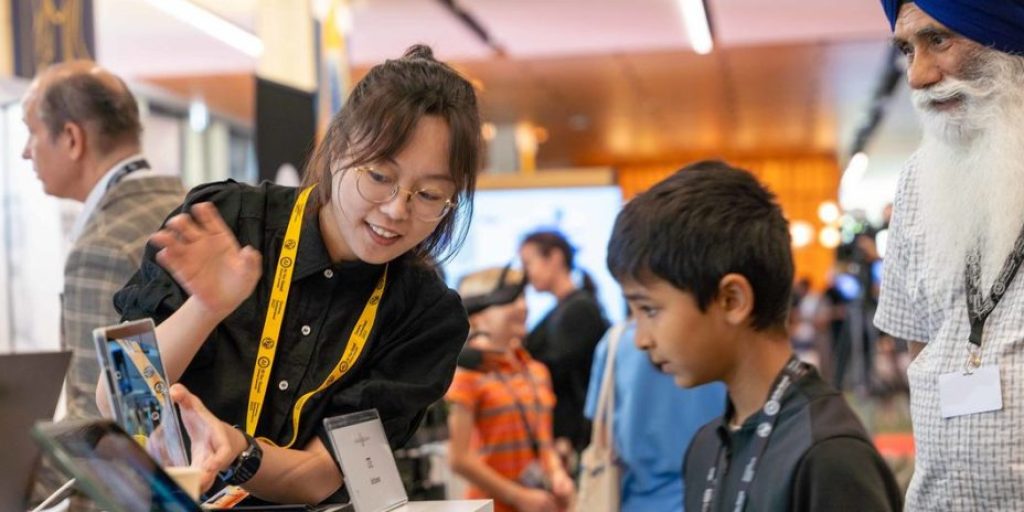
PICTURE: Tech on display at the AI for Good Global Summit/ ITU
Vibhu Mishra
Elma Okic
Geneva
The United Nations’ flagship platform on artificial intelligence opened in Geneva on 8 July 2025, launching four days of high-level dialogue, cutting-edge demonstrations and urgent calls for inclusive AI governance. The event comes as autonomous and generative systems evolve faster than regulatory frameworks can keep pace.
The AI for Good Global Summit 2025 brings together governments, tech leaders, academics, civil society and young people to explore how artificial intelligence can be directed toward Sustainable Development Goals (SDGs) and away from growing risks of inequality, disinformation and environmental strain.
‘We are the AI generation,’ said Doreen Bogdan-Martin, Chief of the International Telecommunications Union (ITU), the UN’s specialised agency for information and communications technology, in a keynote address.
But being part of this generation means more than just using these technologies. ‘It means contributing to this whole-of-society upskilling effort, from early schooling to lifelong learning,’ she added.
But Bogdan-Martin also warned of mounting dangers in deploying AI without sufficient public understanding or policy oversight.
‘The biggest risk we face is not AI eliminating the human race. It is the race to embed AI everywhere, without sufficient understanding of what that means for people and our planet,’ she said
Her remarks reflected a growing sense of urgency among policymakers and technologists, as new ‘agentic AI’ systems capable of autonomous reasoning and action emerge at unprecedented speed.
With some experts predicting human-level AI within the next three years, concerns about safety, bias, energy consumption and regulatory capacity have intensified. The summit’s agenda reflects these tensions.
Over 20 000 square metres of exhibit space at Geneva’s Palexpo now hosts more than 200 demonstrations, including a flying car, a fish-inspired water quality monitor, brain-computer interfaces and AI-driven disaster response tools. Workshops throughout the week will tackle topics ranging from AI in healthcare and education to ethics, gender inclusion and global governance.
One highlight will be the AI Governance Day on 10 July, where national regulators and international organisations will address the gap in global oversight. An ITU survey found that 85% of countries lack an AI-specific policy or strategy, raising alarms about uneven development and growing digital divides.
Closing her keynote, Bogdan-Martin reminded participants that the future of AI is a shared responsibility: ‘Let’s never stop putting AI at the service of all people and our planet.’
- This article was first published here