‘Powerful testament to collective strength, perseverance, unwavering commitment’
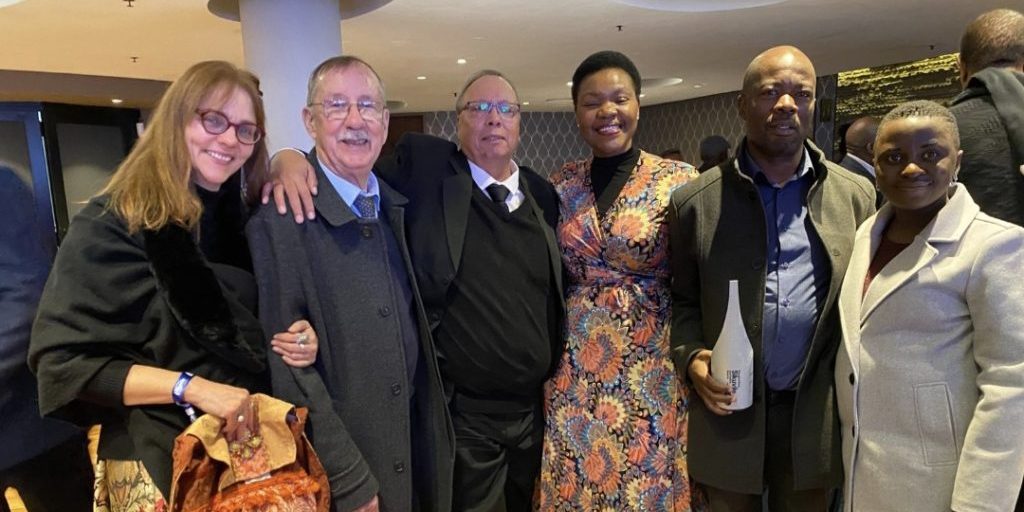
PICTURE: Dunisani Ntsanwisi (second from right) is pictured with his wife, Mashudu (far right), at the 2025 Standard Bank Sikuvile Awards on 28 June with (from left) Association of Independent Publishers’ Kate Skinner, Fanie Groenewald and Tyrone August from the Press Council of South Africa and the Press Council’s Executive Director, Phathiswa Magopeni

Dunisani Ntsanwisi, publisher of Nthavela Titimuleni and a proud member of the Association of Independent Publishers (AIP), was awarded the prestigious Manager/Publisher of the Year accolade at the 2025 Standard Bank Sikuvile Journalism Awards.
This recognition highlights Ntsanwisi’s dedication to growing community media and driving local journalism that informs, empowers and uplifts. Through his Nhluvuko Media, his work has played a vital role in giving rural and township communities a voice, especially in indigenous languages.
Ntsanwisi is also a press representative on the Press Council of South Africa and the community media sub-committee Chairperson at the South African National Editors’ Forum (SANEF).
Janet Smith, a public representative on the adjudication panel at the Press Council, interviews Ntsanwisi
Your journey as a journalist began at Rainbow fm. What were your aspirations then? Were you always intending to develop community media?
From the very beginning, I had a strong desire to create a publication in my own language. I remember receiving a list of registered publications in South Africa and noticing that very few were in indigenous languages. That moment stayed with me.
In 2008, I took the first step by launching a magazine called Nhlalala. It was my way of starting the journey toward empowering communities through language and storytelling. Later, when I approached the Media Development and Diversity Agency (MDDA) for funding, they encouraged me to consider publishing a newspaper instead of a magazine as it would be more impactful and sustainable within the media landscape.
That advice helped shape what eventually became Nthavela Newspaper, a proudly indigenous-language publication committed to informing, educating and uplifting our communities.
Academics describe ‘participation issues’ as being essential to democracy, with media in indigenous languages key to this. Do you agree that the work you are doing is a vehicle for ‘mobilisation’ towards South Africa’s developmental goals as a democracy?
One of the key findings of the Print and Digital Media Transformation Task Team (PDMTTT) in 2013 – as seen in its report – was that, ‘The growth of digital media will certainly open up vast new opportunities for local languages if there are writers available’.
‘This is a matter for the education authorities. In addition to the need for journalists and writers who are able to work in local languages, there is a deepening concern with what is perceived as the declining standards of education and literacy in our schools.
‘The question is whether young people of the future will be able to read newspapers easily, and whether they will have the reading skills to take advantage of the vast amounts of information that they will be able to access digitally.’
In a multilingual country like South Africa, language is not just a tool of communication, it is a gateway to empowerment. Indigenous-language media plays a critical role in ensuring that all citizens, regardless of their linguistic background, can actively participate in democratic processes, social development, and economic opportunities.
If people are excluded by language, they are also excluded from full participation in society. That is why the work I’m doing as publishers and media activists is not just about content. It is about inclusion and the right to be heard and understood
I see my efforts as part of a broader movement to build a South Africa where no one is left out of the national conversation because of the language they speak.
The global decline of print media has had myriad negative effects, including placing additional pressure on publishers like yourself. What have been the most difficult challenges in this respect?
When I speak with fellow publishers, we often say, ‘We are used to difficult times’. One thing this industry has taught us is how to fight. We fight for resources. We fight for recognition. Sometimes we fight even when there’s nothing left to fight for.
It’s no longer just a tactic. It’s part of our survival instinct.
Let’s zoom in on the broader narrative of media decline. Yes, it’s true that mainstream media has experienced sharp drops in audience numbers, revenue and trust. But community media tells a different story.
The decline here is not as severe and there’s a reason for that: community media is rooted in relevance. It speaks the language of the people – both literally and culturally. It reflects their lives, their challenges, their hopes
It has always been close to the ground and quick to adapt, even with limited resources.
If you look internationally in places like the United States, community media continues to hold its own. It thrives in niches, it serves specific local needs and it builds trust from the bottom up. That model works, and here in South Africa, we believe our community media can do the same, if we are properly supported and recognised.
Of course, we face serious challenges. Advertising isn’t coming in the way it supposed to, and the rising costs of printing are an enormous burden. It’s hard to build a sustainable model under these conditions. But the need and the audience is still there.
If government, advertisers and private sector truly want to support democratic access to information, then investing in community media must be a priority. We may be small in size, but our impact is big and with the right support, we can grow stronger, more innovative, and even more relevant in the digital age.
It seems that, today, the greatest push among independent media is to forge collaborations for survival and the promotion of truth. What does collaboration look like in your case? Who are your most important stakeholders?
One of the most impactful steps we’ve taken as a province in Limpopo is choosing to approach advertisers collectively rather than as individuals. This united front has strengthened our bargaining power and improved our visibility in a competitive advertising landscape.
In the community and small commercial media space, no one succeeds alone. Anyone who wants to thrive must build partnerships and collaborate with other organisations – whether it’s for resources, credibility, reach or knowledge sharing.
At present, I have Memoranda of Agreement (MOAs) in place with the University of Pretoria, Nal’ibali and the University of North-West. These partnerships have not only expanded our content offering and relevance, but also deepened our impact in education, literacy and community engagement.
Many community publications, especially those in indigenous languages, are underfunded, under-recognised and often excluded from national advertising campaigns, despite serving audiences that are otherwise ignored by mainstream outlets.
So yes, English-language, urban-centric media still dominates the South African landscape in terms of advertising revenue, distribution and visibility. True inclusivity would mean equal access to funding and advertising, supporting diverse language media and promoting ownership and storytelling from communities themselves.
Until that happens, diversity and inclusivity remain more aspirational than real.
Do you believe that free expression is alive and well in South African media when English still dominates?
South Africa may have one of the most progressive constitutions in the world, with explicit protections for freedom of speech and language right, but in practice, language is still a barrier to full participation in public discourse.
When English remains the default for national conversation, journalism, politics and public information, it inevitably sidelines millions of South Africans who are most comfortable expressing themselves in their indigenous languages.
True freedom of expression is not just the right to speak. It’s the ability to be heard and understood, to engage with issues in your own language and to access media that reflects your lived reality
So, no, we cannot say free expression is thriving while indigenous-language media remains underfunded, and undervalued. Until our media landscape fully embraces linguistic diversity not just as a token gesture, but as a central principle, freedom of expression will remain unevenly distributed.
The government passed the Use of Official Languages Act (UOLA) in 2012. This Act spells out how government structures – including departments, municipalities and parastatals – should go about empowering all official languages and communities that speak these languages.
UOLA mandates every government structure to set up ‘language units’ that should be headed by Senior Managers (here, we are talking of thousands and thousands of jobs in African languages). The function of language units is to produce and disseminate information to communities regarding what that particular structure is doing in languages that communities speak.
So, here you are talking about the production of notices, speeches, reports, brochures, pamphlets and newsletters in African languages informing communities about what various structures of government are doing. Here, you are talking of informed and thus empowered communities. But today, 13 years later, UOLA remains a dead piece of paper whose implementation remains in the air.
Is there a ‘resistance’ aspect to the media we produce, like the community media initiatives we’ve seen among indigenous communities in Latin America?
Absolutely — and it’s still very necessary, even in a constitutional democracy like South Africa. When the majority of people in this country think, speak and dream in indigenous languages, but are forced to consume their news in English, that’s not full expression.
That’s filtered access. It’s a democracy of form, but not yet of substance. The reality is that free expression is not truly equal when Indigenous-language media continues to struggle for funding, recognition and visibility
Advertisers and state institutions overlook small commercial and community publications, and national conversations are framed through a single dominant linguistic and cultural lens.
Yes, we do have a strong legal framework protecting freedom of expression. But the media ecosystem remains deeply unequal. And so, our work as community publishers and indigenous-language media practitioners often takes on the shape of resistance.
In 2019, SANEF commissioned an Inquiry into Media Ethics and Credibility, which highlighted concerns about the lack of content in African languages. Have there been notable advances since then?
Even before government’s Media Landscape Report in 2012 emphasised the need to promote and preserve indigenous languages within the country’s media environment, we were of course very much aware of this. In 2013, the PDMTTT echoed these concerns and made its key recommendation about the promotion of languages.
It said, ‘the PDMSA (Print and Digital Media South Africa) should actively commit to promoting all languages, with a special focus on those that were previously marginalised’, and that ‘this could be achieved by encouraging the establishment of titles in Black languages or through partnerships with existing publications’.
It also spoke about the development of language skills, saying ‘the PDMSA should collaborate with language-promotion institutions to build the skills necessary for publishing in indigenous languages’.
Then, in Media Landscape 2014, a key observation was made that, ‘After 20 years of freedom, there is a multiplicity of voices in the media although the question remains whether the vast majority of South Africans, who are most comfortable speaking indigenous languages, are truly being catered for’.
Fast forward to 2019, when SANEF commissioned the Inquiry into Media Ethics and Credibility. Once again, it highlighted the persistent lack of content in African languages.
These repeated concerns over the years underline a critical point. While advocacy and policy reports have identified the gaps, transformation in the media sector cannot rest on SANEF alone
Following the resolutions of the 52nd, 53rd and 54th ANC conferences, there have been decisions taken on the anchoring and supporting small commercial and community media by government and its state owned enterprise.
These can be traced to the resolutions taken in the 52nd conference, item 124, which indicates: ‘Our government is one of the biggest advertising spenders. Concerted decision by all spheres of government to advertise in the community and small commercial media which produces media in the languages spoken by communities, will assist sustain and grow this media.’
Also, item 128, which read as follows: ‘This may include support for provincial printing presses owned and controlled by media co-operatives. This will help new print media companies to be independent of the big media operators.’
There is growing recognition that everyone must play their part, from government and academia to publishers, technologists, journalists and community stakeholders.
In the last two years, SANEF has made a concerted effort to drive practical change by hosting the Indigenous Languages and Media Seminars in collaboration with partners like the Pan-South African Language Board (PanSALB), the South African Agency for Science and Technology (SAASTA) and the United Nations.
These seminars bring together journalists, researchers, publishers and language activists to share best practices, promote multilingualism in journalism, create training pathways for indigenous language reporting and advocate for inclusive policies and funding
With the UN declaring the Decade of Indigenous Languages (2022–2032), global momentum is also aligned with local efforts providing a critical opportunity for coordination, visibility and investment.
The historical record shows that the call to support indigenous languages in South African media has been consistent for more than a decade. The difference now is the growing sense of collective urgency and action.
With media bodies, universities, language councils and international institutions increasingly working together, the foundation is being laid for more sustainable and impactful transformation, but success depends on continued collaboration, investment and political will.
The environmental crises in our country make for plentiful news. How much have these come to impact your publications?
So yes, the environmental crises have absolutely impacted our publication not just in what we report, but in why we exist. As a media platform grounded in indigenous language and rooted in community, we are committed to amplifying local voices in the face of global challenges.
How much pressure is there on you as a publisher to support the communities which make up your readership to be able to participate online?
In today’s media landscape, access to information and the ability to engage meaningfully online is no longer a luxury. It’s a necessity. Many of our readers come from communities that are still catching up in terms of digital inclusion, whether due to lack of infrastructure, affordability issues or limited digital literacy.
Our role goes beyond simply delivering news. We’re often one of the few trusted local voices that can bridge the digital divide by promoting awareness around online services and opportunities, advocating for affordable and accessible connectivity.
We provide platforms for local voices and businesses to be visible online and offer guidance on how to safely and effectively engage in digital spaces. So yes, the pressure is real for us, but it’s matched by a commitment to ensure our communities are not left behind in an increasingly digital world.
Supporting online participation is part of our broader mission to empower, inform and connect.
 You are making a significant contribution to language preservation in general. How are you getting involved in the fight for big tech to promote language development in AI in indigenous languages?
Thank you for that thoughtful observation. Language preservation is a cause close to my heart. While I don’t lead initiatives myself, I proudly support the incredible work being done by indigenous technologists, researchers and advocates who continue to push big tech toward more inclusive and representative language practices.
Nthavela will soon be collaborating with the University of North West on a language corpus initiative: a significant step in building digital resources that reflect and preserve our linguistic heritage
Efforts like this are foundational in ensuring our languages not only survive but thrive in online and technological spaces.
You’ve created many opportunities for monetising indigenous language media, but is it a battle to get advertisers to support your publications?
We’ve worked hard to create new opportunities for monetising indigenous-language media through partnerships, collective bargaining, community engagement and by building a loyal, responsive audience. But yes, getting advertisers to truly support our publications is still a battle.
And it’s not because the audience isn’t there. It is. The challenge lies in how advertisers perceive value. Many still see reach and prestige in English-language, mainstream platforms, overlooking the depth and loyalty of audiences in community and indigenous-language media.
There’s a bias toward urban, digital-savvy markets, even though the majority of South Africans still engage with print and local platforms, especially in rural provinces.
Advertising agencies often follow legacy media plans that exclude grassroots media, either by habit or lack of awareness. This means we’re constantly having to prove our value, even when we have the numbers, the community trust and the hyper-local impact that mainstream outlets can’t offer.
That’s why, in Limpopo, we’ve taken a collective approach uniting as community publishers to engage advertisers with one voice. It’s harder to ignore us when we come together. And it’s slowly starting to shift the narrative.
How will the Digital News Transformation Fund and the Journalism Sustainability Fund assist with the work that you do?
As a publisher of an indigenous-language community newspaper, I see these two funds as lifelines, not just for Nthavela, but for many small and grassroots media organisations across South Africa.
We face significant challenges moving from print to digital from skills development and infrastructure to content adaptation. The Digital News Transformation Fund can help us with digitising our content for wider reach, especially among younger audiences.
It’s important to invest in mobile-friendly platforms, since most of our readers access news via phones. Our staff need to be trained in digital storytelling, social media and data journalism in indigenous languages.
The Journalism Sustainability Fund could help develop diverse revenue models including subscriptions, events, digital advertising and donor-funded projects. Administrative functions like marketing, audience development and business development are areas that are often under-resourced in small newsrooms, and need support. Capacity-building needs funding, so we’re not just surviving month to month, but actually planning long-term.
Unlike mainstream media, we don’t just report news. We do so in the language of the people, and in a way that reflects their culture, values, and lived experiences
These funds can help protect and promote indigenous-language journalism, ensure our communities are not left behind in the digital shift and enable us to tell local stories with national relevance in our own voice.
If these funds are distributed equitably and strategically, with real support for small publishers outside of major metros, they have the potential to reshape the South African media landscape for the better. And for us, they could mean the difference between disappearance and digital rebirth.
How much opposition is there from mis- and disinformation peddlars to the work that you do?
There is no doubt that misinformation and disinformation are a growing threat not just to national media, but especially to community publishers like us.
We may not always face direct attacks from organised disinformation networks, but we feel the opposition in subtle and powerful ways. False rumours spread faster than the truth, especially on WhatsApp and Facebook.
Community trust being undermined by fake news dressed as legitimate updates.. Competing voices spreading politically or commercially motivated disinformation, making it harder for our fact-checked content to be believed.. This creates a constant battle.
We don’t just have to report the truth – we also have to fight for belief in the truth. That’s why community media needs more support, not less, to build stronger verification practices, to collaborate with fact-checking organisation, and to rebuild public trust from the ground up, because where trust is broken, democracy weakens. And in our communities, we are often the last line of defence.
 What does winning the Standard Bank Sikuvile for Manager/Publisher of the Year mean to you?
Winning this award is not just a personal achievement. It is recognition for our entire small commercial newspaper sector. Too often, when one publication is found to be non-compliant, the whole sector is unfairly judged. This award proves how vital and relevant our sector truly is.
Over the past two years, we have witnessed massive retrenchments across the media industry. Every media house is struggling, yet we have managed to survive and continue serving our communities.
At a time when it seems impossible for small newspapers like mine to win national awards, publications such as Seipone Newspaper, iDike-lethu News, Masilonyana News, Phumelela News and Bushbuckridge News, among others, have shown remarkable resilience.
This award is a powerful testament to our collective strength, perseverance, and unwavering commitment to keeping local journalism and our languages alive.