International media outlets unite to investigate, take forward Palestinian journalists’ stories
Media resources, Press Freedom, Updates
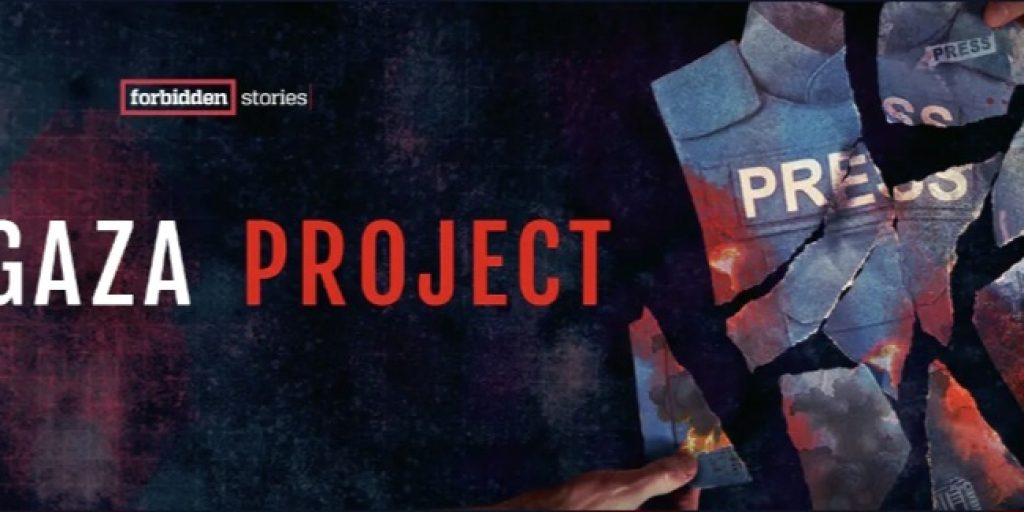
Five months after the first part of the Gaza Project was published in June 2024, Forbidden Stories and its partners launched another international collaboration focused on the war Israel is leading in Gaza.
‘The first part of the project was extremely important,’ Hoda Osman, Executive Editor at Arab Reporters for Investigative Journalism (ARIJ), said. ‘At ARIJ, we managed to publish the stories in Arabic more than 100 times through various outlets. While the project didn’t really lead to formal [judicial] investigations (…) it did help raise awareness and focus the attention on the issue.’
Nor did the investigation stop the carnage of Palestinian journalists.
Since 7 October 2023, about 170 Gazan journalists have died, according to the Committee to Protect Journalists. Some were targeted by the Israeli army, while others were killed alongside other civilian victims of the massive bombardments that have ravaged Gaza for months.
‘Unfortunately, we have to resume [this investigation],’ Palestinian journalist Walid Batrawi, consultant for Forbidden Stories, emphasised. Osman says, ‘We had to do it.’
‘More journalists have been killed. There was a brief pause during the cease-fire but it resumed. Each case deserves an investigation’
At the risk of their lives and mental health, our Palestinian colleagues continue to work in appalling conditions. Since the war began, Gaza has remained off-limits to foreign journalists with only rare exceptions. Local journalists, therefore, bear the brunt of the risk in order to ensure that information continues to be reported from Gaza.
The Israeli army did not respond to our request to enter Gaza while the ceasefire was still in effect.
More than 40 journalists from 12 different media outlets participated in this new collaborative investigation.
For Nicolas Falez, a senior reporter at RFI and former correspondent in Jerusalem, taking part in an international investigative consortium was a new experience.
‘I discovered the obvious benefits of combining our skills,’ he said. ‘We’re all familiar with the vertical and pyramidal organisation of our newsrooms. I was very interested in joining forces horizontally’
This collaborative effort has allowed us to recount in detail how the Israeli Army deliberately targeted journalists using drones. Among them was Mahmoud Isleem Al-Basos, who had filmed for the Gaza Project and was killed several days later in an Israeli drone strike on 15 March in Beit Lahia while escorting a humanitarian convoy.
The Israeli Army declared that, on that day, it specifically targeted ‘terrorists’ using a drone, but without backing up those claims.
Accessing unpublished documents from several Israeli ministries, we can also unveil the strategies deployed by the Israeli government to try to shield the Army and its officials from accountability before international courts. In some cases, the Israeli government went as far as to accuse Palestinian journalists – and the NGOs that defend them – of terrorism.
Killing the messenger will not kill the story. Coming together, we took forward the work of reporters who were killed while using drones to film the ruins – one of the only ways to show the extent of the damage to Gaza.
Several days before he was killed, Al-Basos filmed and shared drone footage with the consortium. His work was then combined with modelling techniques developed by the open source investigative group, Bellingcat. The immersive, interactive 3D aerial maps of the Al Shati and Jabalia neighborhoods help readers visualise the scale of the destruction in an unprecedented fashion.
We also tell journalist Al-Wahidi’s story in detail. Paralysed in a hospital bed in Gaza, the journalist told us about the day he was seriously wounded near the Jabalia refugee camp while wearing his press vest. He and his friends are convinced that the Israeli army shot him intentionally. Al-Wahidi said, ‘It was a targeted assassination [attempt] … It was a direct hit.’
On 24 March, journalist Hossam Shabat was killed by an Israeli drone while riding in an Al Jazeera car. ‘I wear a press vest and a helmet. We always try to be identified as journalists so that the occupying army has no excuse to target us,’ he had explained to Le Monde in June 2024, as part of the first installment of the Gaza Project.
Aware of the danger, he had entrusted a message as a testament to his relatives. They published it on X after his death. The 23-year-old journalist wrote: ‘By God, I fulfilled my duty as a journalist. I risked everything to report the truth, and now, I am finally at rest’
In short, he asked the people who’d read him to ‘keep telling our stories’.
This is the very essence of the Gaza Project.
The Gaza Project 2025 partners
ARIJ
RFI
Bellingcat
Le Monde
Forbidden Stories team
Director of publications: Laurent Richard
Editor: Frédéric Métézeau
Journalists: Mariana Abreu, Sofía Álvarez Jurado, Cécile Andrzejewski, Magdalena Hervada and Youssr Youssef
Publication co-ordinator: Louise Berkane
Video journalist: Anouk Aflalo Doré
Fact-checkers: Emma Wilkie, Mashal Butt
Copy editors: François Burkard, Mashal Butt, Simon Guichard, Christopher Knapp
Translators: Amy Thorpe, Léontine Gallois, Paciane Rouchon
Communication: Alix Loyer, Emma Chailloux
Web integration: Thibault François, Louise Berkane
3D models
Thomas Bordeaux(volunteer for Bellingcat’s Global Authentication project), Mahmoud Isleem Al-Basos, Jake Godin (Bellingcat), Magdalena Hervada, Youssr Youssef
- This article was first published here